Sense is dedicated to empowering people with complex disabilities to lead creative lives. They deliver accessible programmes that give everyone the time and space to take part. People with complex disabilities are at the heart of everything Sense do and inform their principles for inclusion.

Moving Portraits Case Study
Hafan » Case-studies » Moving Portraits Case Study
‘Moving Portraits – What Does It Mean To Be Me?’ was an inclusive screen dance film commissioned by Sense and was presented as part of Birmingham 2022 Festival.
It captured and shared physical stories of people with complex disabilities and the film centres on the stories of people Sense supports. Each ‘portrait’ focusses on a dancer from their diverse community of people, from young adults, to older people. Sense won the ACE digital inclusion award for the film in March 2023.
With thanks to Stephanie Tyrrell, Head of Arts at Sense and Toki Allison, Inclusive Cinema Project Manager for this case study.
Stephanie Tyrrell (ST), Head of Arts at Sense, in conversation with Toki Allison (TA), Inclusive Cinema Project Manager:
TA: Who are Sense?
ST: “Sense is a national disability charity, we have a number of services across the country, including day services , colleges, care homes, community hubs, holidays and short break, sports and wellbeing programme . We support people with complex disabilities of all ages.
Originally Sense supported deafblind children, but we now support people of all ages with complex disabilities. This means somebody with two or more complex disabilities whether that’s physical disabilities or neurodivergencies.
The arts and wellbeing team has been around for the past 10 years, created to provide enriching experiences to the people we support, offering different arts and wellbeing activities.
We are challenging the concept of culture in care, everything we do is led and co-produced by the people we support, and we’re working towards 50% of our freelance work force to identify as having a disability.
We’ve always tried to be like, let’s bring that in, whether it’s working with gallery spaces, museums, theatre, music. There’s been lots of learning about the representation of people we support and we want to bring that to a wider audience.
We always want to celebrate what we do but if you take a performance environment for example, this can be very ‘un-inclusive’, there’s often an unsaid pressure with a live audience and that electric feeling just before can be really destabilising for somebody, for other not so much but we’re always thinking how we can share creativity in the best possible way.
So then we were working with Birmingham director Sima Gonsai – she came to one of our dance performances and she said “This is brilliant, you should capture this on film.”
Since then we’ve produced two films, Suspended Motion a Moving Portraits which we sent off to lots of screen dance festivals, and we’ve got some accreditation and won awards.
Moving Portraits was in celebration of the commonwealth games – exploring representation and the people we support. We made the film with access as it’s core. The more traditional levels of access don’t always work for the people we support, often because they’re non-verbal and it’s nonverbal communication.
So that’s where we devised the SubPac sound scores;
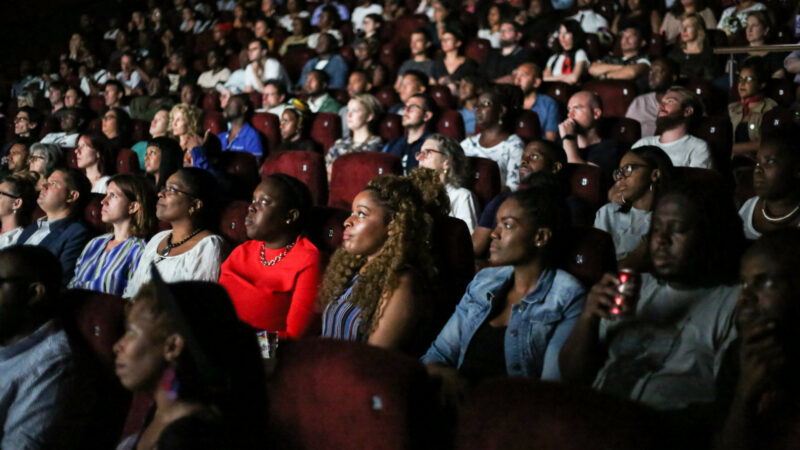
First level of access is to offer audio description and BSL captioning. And, then for audiences who are nonverbal or have other forms of communication, we created a sound score that vibrated using SubPac vests, so the SubPac vibrates to the same frequency as what’s happening on screen so that we’re creating this like, gorgeous, inclusive environment in which people can come in, be together in a screening environment, and see a piece of work see themselves in that work, and also have the same experience.
The transformation it has on people in our services is so self fulfilling, kind of like being in that space, having the impact and celebration of seeing themselves on screen, others or seeing them on screen at the same time. It’s really profound and we want to keep doing that. We want to keep bringing the work to audiences so that they can see that there are people in very marginalised groups within society that can contribute and have something to say and, and are here and are visible.
We try to support different arts organisations to think differently and that the little differences can just go so far.”
TA: What were the aims of the project? So, what exactly did you hope to achieve out of it?
ST: “I think it’s really interesting because when the Commonwealth Games…the Cultural Festival launched (and a lot of organisations say “yes, we are open to everyone!”).
And they mean everyone: “like everybody can come in …we’re here with open arms, everybody come in”, but actually, we’re talking about the whole spectrum of people, we’re talking about …everyone because you can’t just have like an ethos of “yeah, we are welcome, come in”.
There are practical, tangible steps to take so that you can welcome everybody.
And, so that’s I think that was the main remit of trying to showcase the people we support, bring them to new audiences, and to try and shove aside space for people with complex disabilities to be a part of what’s happening out there.
And to explore access to go okay, if captioning. If audio description doesn’t work, what else can we do? And that was part of it with the vibrating kits.”
TA: And would you say you achieve those aims overall?
ST: “It’s really hard, because there isn’t a blueprint for this, but it was successful.”
TA: In terms of the setup for how you delivered the project, what was your process in terms of funding and delivery? What does it need in terms of resources, how many team members did you need etc?
ST: “So, some of the people in the video, we’ve been working for a long time, and some of them were new to us this year – so it was a really mixed group.
For example, Joe, who was in the third film that I showed, he was dancing with Becky. It’s taken Joe about seven years to get to that point where he feels confident. So for him to get to the point where he can confidently bend over somebody else and do a position, that’s taken years to get there.
Whereas the older persons group…they were new groups…we would have to have two or three professional freelance artists within the space delivering the work, because it’s so varied, we always try and have one or more artists delivering in that space.
We then have Lisa Simpson (artistic director for Sense and the National Inclusive Dance Programme) who because of her own health requirements… and because we started this process at the beginning of the year, when people weren’t going out as much as they are now or if you have still have health conditions, people are much more nervous, so our coordinator would stand in the theatre space with Lisa on the laptop and she would give direction to the artists within the space and they would respond that way. We would then have the film team, the film crew setup with the lights and the actual filming days were during the heatwave this summer and so you would literally have 20 minutes to shoot.
And, so with all of the artists and all of the film crew there you have resilience as an artist to go “Okay, we’re gonna let that go. Kira wants to be on the floor. She’s on the floor, that’s what we’ll go with.”
So, the level of resilience and patience it took from everybody was high.
You’re constantly flexing these like, access needs to ensure that everybody can be in the space as grounded and as independent as possible but sometimes you’re gonna get that wrong and, you know, as much as you can try and be organised with that stuff, sometimes it it can go wrong, but just asking the questions, you know, it’s just really it’s a really good starting point.”
TA: Is there anything else that didn’t work or anything you’d do differently? If you did it again, or any learnings you’d share beyond what you’ve already said?
ST: “What would I do? I do exactly the same and all different at the same time!
I think there’s more to unpick with the vibrational sound scores, I think we could spend a lifetime exploring how that impacts engagement for audiences or research into…”if we have this vibrational score, does that connect you to the films in a more meaningful way?”
We haven’t done that bit of research, so that could be a piece of work that is out there.
What we have done is gained observational feedback from the people we support, experiencing the film with the sound scores, because we work with so many neurodivergent people self-reporting does exist but can always be interpreted in a different way.
We’re really at the point now where we just want to take the work out there, celebrate it and share it and to support other organisations to think about how they could work more inclusively.
It’s almost like a tool, a talking point to kind of, you know, for people to go “Wow, I’ve never seen somebody with a complex disability dance before or Yes, I’ve seen this lots of times.”
TA: Were there any sort of key partnerships with other organisations that you’re working with?
ST: “Obviously the artists – the freelance artists, Lisa (director), the freelance dancer artist Richard Shrewsbury (who is a lecturer at the Conservatoire) he did the sound scores and Zoe Partington did the audio description.
The Rep Theatre gave us their theatre space in-kind and then Flatpack (Amy) were just like a godsend because they could just help with all the tech support and their technician helped with how we were going to show the piece…that was just a dream to work with those guys. Massive love for them and the project!
TA: Budget wise if you’re able and happy to share…what, what did you need to achieve this project? And how did that change? From maybe what you’d scoped in the beginning to what you actually ended up with?
ST: “I think one of the barriers is that you know, to be inclusive, to have the right interpreters in the space can be expensive.
So, I think in terms of the access support, that was one of our biggest costs and making sure that we had the right support in the space, but if organisations get into space where they can just auto describe themselves, you don’t have to have somebody doing different audio description. I guess the biggest cost was the tech side.
I think the film was between £40-£60k – a big portion of that was access and sharing and kit for the screening and the filming for the high quality finish.”
TA: I think it’s just helpful for people to know roughly what these kinds of projects cost and what to apply for if they’re gonna try.
ST: “It was an Arts Council funded project and we had letters of support from Flatpack, Lisa, we’re also working with Studio Wayne McGregor… then the Commonwealth Games as well.
But I think if all organisations are looking at putting in budgets together, you know, start with access, make sure you’ve got enough for BSL interpreters, or audio description. Or if you’ve got anybody that’s tech savvy within the organisation that could do live captioning or things just to have that as a consideration at the start.”
Videos:
- Moving Pictures,
- For Lisa, choreographing is like designing with bodies,
- Sense TouchBase Pears Studio Tour,
- Suspended Motion – Screen Dance Film.
- SubPac.
Geirda
“The positive impact has been significant. [Kira has] always found new spaces and transitioning quite difficult. However, this term she has really come out of her shell and is far more confident, engaged & mobile around college, with an increased willingness to engage in new experiences. I believe a huge part of this success is due to the phenomenal work your dance instructors have done with her during the dance sessions. The impact of this is seen in pretty much every area of her college day [...] the positive impact they have made on my student is amazing.”
Kira’s College Tutor
“With thought and planning, you can make a performance accessible for everyone.”
Birmingham 2022 Festival Audience Member
“This piece displayed both the accessibility of dance for everyone as well as creating an experience to watch it.”
Birmingham 2022 Festival Audience Member